Sunday, September 19, 2010

Seven points of advice for young artists


After giving an artist talk at my solo show “Era Dorada” (Golden Age) at the Sagrado Corazon (Sacred Heart) University of Puerto Rico, I was asked to offer some words of advice for young artists and art students. I gave them a few at the moment but after that I felt the urge to really think about the matter and write down a list of seven points of advice that could serve as a simple guideline for those who are starting out as artists. Of course this list could also be applied to any artist at any stage as in my case being a mid-career artist these seven points are the laws I try to live up to all the time. By following these seven points you may be able to channel and get the most out of your creative energies.


 1.      Read. Feed your brain with good books. Study as much as possible and make it part of your daily activities. Stay focused, keep your intellect alive and nurture your mind with healthy intellectual activities. These do not necessarily have to be related to art as everything in one way or the other informs art and will influence your creative mind. Be open to be challenged by new ideas and feel curious to constantly learn about new issues that are of your interest. Be continuously curious to learn, ask yourself questions and look for the answers. The internet is a great tool, use it properly.

2.    Keep a Journal and document everything you make.  Write and draw every day, make it a habit and a discipline. This will keep your creative flow alive and to know yourself. With this you will be able to hold on to new ideas. Much of the creative blocks can be avoided or removed by this simple practice. Do not worry if the drawings or writings seem stupid or irrelevant. This journal is private and it’s a way of having an intimate look into your inner creative being so you can access it at any moment. Affirm your thoughts and beliefs, write and re-write your artist statement. Document not only your ideas but also your work with a portfolio with good photos of your work.  Start photographing even your drawings. In case your work is lost or stolen, you will have a visual evidence of your artwork. Besides being an effective professional tool it will allow to view your own evolution later on.

3.    Make a work schedule. Sometimes it is hard to keep up with production at the studio. There are so many things to do that keep us away from making art.  Assign yourself a time and space to work as much as possible but also leaving time for other important activities as well as a time to relax.  Be realistic, know your limitations and be aware of your responsibilities. Start viewing your studio time as important as any other job, not expecting to be visited by a muse  or inspiration but working a certain amount of hours a day. For an artist his or her work is central and he or she works as many hours a day as possible.  Some artists work 7 to 8 hours a day just like any other full time job. Discipline is the keyword here.

4.    Share your art.  Art is not only about creating work hidden in your studio but also about meeting new people like artists, gallery owners, collectors, art lovers and anyone related in one way or the other to the arts and culture. Be open to share your art not only with other art related people but also with people who do not have any connection with art. I find this to be a perfect opportunity for them to learn something new and for myself an opportunity to hear a different point of view as I practice how to speak about my art.

5.      Experience the world. Study nature first hand. Learn from direct experience as well as mediated experience. Learn to appreciate and experience what is around you. Go out and visit a museum, watch a movie, go to the park, spend some time with friends or join a group. Participate in healthy activities and expose yourself to the world.  Live life outside the studio and allow these experiences to inform your vision of the world.

6.      Be open to be critiqued Detach yourself from your work and listen to different points of view once in a while. Let go of your ego. This often hurts artists who feel they are too high above everyone else. Be open to be critiqued by other artists as well as people who do not have anything to do with art. Learn how to defend your work objectively and without getting too personal about it. With mutual respect we can listen and learn from even a child. Your art will have a different response from person to person and it’s good to take note of these individual reactions.  Also be aware of who and what kind of person is giving you advice. Always be yourself and carefully examine advice from people who want you to be like everyone else or like themselves. Be ready to question the reasons. Critiques are a healthy way to learn and grow as an artist.

7.    Dare to be different. If you see most artists painting large canvases, paint on small panels. Go against the mainstream; avoid becoming an imitator of current styles and trends. The best artists I know of make their own way and do not follow the masses or make what everyone expects them to do. Look into yourself and search for those qualities that make you especially different from other artists. Explore and take these differences further with your work so you may stand out of the crowd. This could make a huge difference on how others view and remember your work and you as an artist. For this it is important to follow the advice #2.

Hope these words of advice are of help to those young artists out there who wish to pursue art seriously. As a last word I should add that in this life I’ve learned that being an artist means much more than just having talent. Many good people out there have talent but do not take themselves seriously. I’ve seen poorly skilled art students and artists persist and keep practicing non-stop and after years of hard work they have become accomplished artists. So I say it’s not a matter of talent but on how much you wish to become something and how much you work for it!

All text on this blog entry is copyrighted material© by the artist and author Patrick McGrath Muñiz

Sunday, August 29, 2010

"ERA DORADA" Reinterpreted myths for a global age

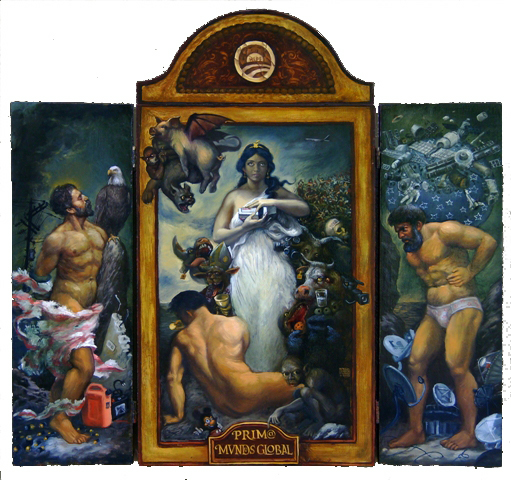
Next thursday September 2nd of 2010 I'll present my newest work in an exhibition titled "ERA DORADA" (Golden Age) at the gallery of the University of Sagrado Corazon in Puerto Rico. On this solo show I have included 22 pieces that are composed of drawings and paintings in ink, tempera and oil on canvas and panel. Inspired in Western mythology, religion, art and colonial history I have reinterpreted some of the myths  and doctrines of our own Global age. 


"Deuscoverymiento" (2010)

"ERA DORADA" (Golden Age) responds to our global age with its current crisis and prevalent mythology. In these oil and tempera paintings on canvas and panel, I have created an anachronistic imaginary world, where pagan gods, heroes and saints are resurrected from the vestiges of a post-consumer landscape. As they emerge from the ruins of a declining empire, we are confronted with the survival of the myth of the "Golden Age". This myth presents a Utopian existence when life seemed to be unspoiled by the proposed set of values from a culture based on profit and consumerism. The work opens up a Pandora's Box of questions about how we got to our present global condition. 


"The Secret Box" (2010)

Inspired by recurrent Classical and Christian Iconography in Western art, I paint on small "retablos" adopting Renaissance and Baroque painting techniques. This enables me to emulate previous strategies through indoctrination devices that remit to the time of the conquest and colonization of the Americas. Painting allows me to recreate intimate theater stages where I set up and orchestrate mythical and historical figures into satirical narratives that mirror my world today. Exposing a dialogue with history and mythology allows me to question today's assumptions of the demise of colonialism, borders and the myth of a new global age of peace, prosperity and equality. 


"Obamus the lightbringer" (2010)

With the ruling omnipresent corporate global economy that diffuses and perpetuates its myths and doctrines over the globe through mass media we may ask ourselves: what hidden agenda do we finally serve by adopting these myths and doctrines? Where do our views of the current world come from? How was this information modified over time our attitudes towads nature, history and ourselves?


"Arcana 21" (2010)

"ERA DORADA" will open on September 2nd at 7:30 pm and will be exhibited at the gallery of Sagrado Corazon University until October 29th of the present year. For more information in Spanish you may visit the University website at:

Thank you very much for your support and please feel free to contact me by e-mail in case you have any questions regarding my work. You can e-mail me at: retabloarts@gmail.com. I look forward to hearing from you, seeing many of you at my show and hope to keep producing good work and sharing it with all of you! Future shows will soon be announced!

All text and images on this blog entry is copyrighted material© by the artist and author Patrick McGrath Muñiz

Saturday, August 14, 2010

Reflections on numbers, shapes and colors in art

"Color is the keyboard, the eyes are the hammers, the soul is the piano with many strings. The artist is the hand which plays, touching one key or another, to cause vibrations in the soul."
-Kandinsky
In recent years my research has led me to find out some interesting connections between forms, colors, numbers and divine archetypes. Of course I will not be the first or the last to find  spiritual truths hidden in the colors of my palette, compositions and even the number of colors and shapes I use. In the past it was not uncommon to find painters experimenting with alchemy and studying astrology besides theology and philosophy.  Phillip Otto Runge, a Romantic German painter from the nineteenth century often imbued mystical qualities in his work. Runge believed that every form and color besides describing reality in a painting, they also revealed universal truths. Runge, a Christian considered the primary colors to be the sacred colors of the Trinity, equating God with the color blue, The Holy Ghost with yellow and Christ with red.


Morning by Phillip Otto Runge, Oil on Canvas 1808

A very common religious theme during the Renaissance was that of the Holy family, depicting the Child Jesus, The Virgin Mary and Saint Joseph. One can find in numerous depictions, certain colors repeatedly used for each one of the members. Usually The Virgin Mary is dressed in blue and red or white while Saint Joseph is wearing purple and orange. These colors are splendidly painted in the compositions of Italian painter Raphael Sanzio. The coloring and triadic composition vividly idealizes the serene figures. This recurrent use of color to identify specific Christian Icons has the purpose of teaching the gospel through images easy to remember for the illiterate. 


Holy family with palm tree by Raphael Sanzio, Oil on tondo canvas (Unknown date)


Modern painter and art theorist Wassily Kandinsky, credited with creating the first abstract painting.  wrote in 1911"Concerning the spiritual in art". Influenced by music and theosophy, Kandinsky in his time, developed not only a new way of painting but a new way of thinking about paint. Painting after all in its essence is an abstract substance. Colors can have a double effect upon us. First and obviously we feel attracted to colors by looking at them but this occurs at a physical/senses level. If we keep staring at a painting for long enough we might start feeling spiritually elevated (or depressed, depending on the work, vibe and intention of the artist). This mysterious feeling of lightness, internal peace and joy is transmitted by  a painting the same way as a beautiful classical tune does.  It soothes the soul in the most sublime way and this is what drove Kandinsky towards abstraction and the study of the mysteries behind this experience. 


Composition VII by Wassily Kandinsky, oil on canvas, 1913

In "Concerning the spiritual in art" Kandinsky notes that different colors evoke different reactions on the human soul. For instance blue is cold, distant and celestial. Yellow is warm and terrestrial. Mixing yellow and blue create green which is immobile and calm like vegetation, a union between the terrestrial and the celestial. These associations not only come fourth from experience with nature but with the subjective experience with paint itself. As with colors we can also respond in different ways to form. A triangle will communicate to us differently from a circle or a square. Number in a painting also plays a very important part. We certainly do not interact in the same way when we are confronted by a single painted portrait as we would do with a whole battalion of figures in a large composition.  Besides having natural associations, colors, forms and numbers have cultural considerations and personal interpretations as well. Aware of this we can carefully venture into the subjective world of art wearing a mystic's robe and understanding art spiritually rather that materially.The following is just an overview of how one may interpret some  forms, colors and numbers in a painting:

Numbers:


One- The individual, the unity, the Uni-verse, the absolute God,  the monad, the whole. the planet, the sphere, dot or single circle  According o art theorist James Elkins, "Paint adds like this: 1+1=1. Contrary to a mathematical mind, art is experienced as a "whole" with everything related to each other and being part of the same thing.


Sun god Shamash receiving the solar disk, his emblem of power,  relief  9th century, Babylonia


Two- The pair, male and female, duality, deadly opposition or romantic encounter, the line with a beginning and end. Two is also becoming fundamentally conscious of ourselves by consuming the forbidden fruit of the tree of knowledge of good and evil.


Adam and Eve by Albert Durer , engraving, 1507


Three- The Trinity: The Father, the Son and the Holy Spirit or the Mind, the Soul and the Body. The triangle or pyramid is the establishment of a relationship through reconciliation. Out of the thesis and anti-thesis a synthesis is born. In Christianity there are three theological virtues: Faith, Hope and Charity. Three is associated with the spiritual realm. Three is an artist, his material to work with and his inspiration or concept. Three is a couple and the love that unites them.   
Traditional diagram used to described the Mystery of the Trinity

Four- Material creation, substance, an artist with his material to work with, his inspiration or concept create the masterpiece, this is four. Four elements (fire, air, water and earth) are needed to describe matter. Four are the cardinal directions, four seasons and four the primary colors (Red,Black, Yellow and White) for the ancient  Mayans Egyptians and Greeks. Egyptian god Horus had four sons who guarded the four canopic jars into which the four most important organs of the deceased pharaoh were kept.  In Christianity there are four evangelist that are represented by four sacred animals.  The cross has four ends.

The Celtic Cross


The Zodiac wheel divided up in four parts that define the winter and summer solstices and spring and autumn equinoxes.


The four Egyptian canopic jars that kept theorgans of the deceased Pharaoh.. Duamutef, the jackal headed god represented the east and kept the stomach, Quebehsenuef, the falcon headed god represented the west and kept the intestines. Hapi the Baboon headed god represented the north and kept the lungs. Imseti, the human headed god kept the liver and represented the south.


Seven:  The sacred number. Seven are the colors of the rainbow, the traditional musical notes, the wonders of the ancient world, the number of Chakras in the human body, the vices and virtues, the days of the creation in Genesis and the days of the week. Seven is the union of three spiritual principles with four material principles. It is the number of growth, and completion.


The Menorah is a Jewish symbol candelabrum with seven branches, used as a portable sanctuary and a symbol of universal enlightenment. 


Shapes:

Circle or dot: The atom at a micro-cosmic level , the solar system as a macro-cosmic level. An apple, an egg and a human head are all derived from the idea of a circle. The circle is organic,it pulsates with life,  its life itself, full of potentiality, the cell , the microscopic organism in evolution and also the Sun and the Moon. It is also accepted as the symbol of eternity and never-ending existence.


Single Cell Plant


The Cylinder  or line: Phallus, temple column, tree, building, sword, serpent, action, vertical or horizontal trust and movement, road, direction, arrow  and bullets.


 Corinthian column

Square, rectangle or cube :  House, temple, man made, box or container, a product of culture. Enclosed space, cage, nature reshaped and repackaged by the logical and "square" minded.


Temple to Bacchus at Baalbak, Beirut

Triangle or pyramid: God's supreme wisdom, The Trinity, spirituality, eternity, life after death, ascension, if it points to the sky, descending if it points to the earth. Human's stairway to the heavens,  Sacred in ancient Mayan and Egyptian civilizations.


Pyramid at Chichen Itza, Mexico

Colors:

Black: In alchemy blackness is called the nigredo and is considered the "materia prima" from which the philosophers work is to begin with. It is earth, excrement, and black bile. The impure, chaos, lead, death, the underworld, primordial darkness. It is absence of color and therefore or life.

White: The sacred and pure, perfection, illumination, innocence and chastity. Unicorns in medieval art are white. The "albedo", second stage  in the  alchemical also represents  the Moon, water and phlegm.  A white flag stands for surrender and peace. 

Yellow: Divine splendor, the Sun, solar light, gold, also denotes jealousy, ambition, greed. In alchemy it is called Citrinitas and means "yellowness". It stands for urine and air. It is also the color of Apollo, Sun god, pure spirit and intellect. 

Red: Passion of Christ, love, blood, Ares, god of war, agitation, physicality, energy, virility, health and  strength. In alchemy it is called "rubedo" and is symbolized by the "glowing lion" It is fire and the last stage in the alchemical process revealing the philosophers stone.

Blue: Celestial, distant and cold, blue is the color of the Virgin Mary,  mother of God, often associated with the Holy Ghost and the Heavens. It also stands for revelation, wisdom, the sky and the seven seas.

Purple: Imperial power, Royalty, truth, justice and temperance. Priesthood. The color of Jupiter, king of of the Olympian gods, In Christianity it is associated with God, the father.


Again these are just some cultural interpretations of some  numbers, colors and forms mostly informed mostly by Western Judeo-Christian tradition. For further reading in the subject I recommend J.C. Cooper's Dictionary of symbols,  Wassily Kandinsky "Concerning the spiritual in art", Signs and Symbols in Christian art by George Ferguson and Barbara G Walker "symbols and sacred objects". In future blogs, I shall talk in more depth about each one of these colors, shapes, numbers and their specific meanings in art.